
Revenue cycle leaders have never had access to more information. There are dashboards, reports, KPIs, productivity measurements, payer data, claim status information, denial reports, A/R reports and financial performance metrics. And yet, one of the most important questions in revenue cycle management remains surprisingly difficult to answer:
What is actually happening inside our revenue cycle, and why?
That is the difference between having data and having intelligence.
Data is necessary, reporting is necessary, and analytics are necessary, but none of them automatically create understanding. The opportunity is connecting that information to the operation.
For revenue cycle leaders, that means moving beyond simply knowing what happened and toward understanding what changed, why it changed and where action may create the greatest impact.
Your RCM reporting should answer more than “what happened?”
A report might tell you that your net collection rate declined and while that’s important, leadership needs to be able to move beyond the number.
- What changed?
- When did it change?
- Where did it change?
- What contributed to the change?
- Is it isolated or systemic?
- What should we do about it?
Those questions are what turn a report into something leadership can actually use.
A Better Way to Look at Your RCM Data
- Can you see it?
At the most basic level, leaders need access to timely information.
Can you see your key performance indicators without waiting for a monthly report? Can different leaders access the same information? Are teams relying on spreadsheets or manually assembled reports to understand current performance?
Visibility is the starting point.
For organizations already using an RCM platform, this can be less about finding another reporting tool and more about making sure the information already being generated is accessible, timely and useful.
- Can you understand it?
Seeing a number is not the same as understanding it.
- If your denial rate changes, can you identify what is driving that movement?
- If A/R is aging, can you identify the operational areas contributing to the change?
- If clean claim performance declines, can you see where the breakdown is occurring?
Data without context can create more questions than answers.
- Can you connect it?
Revenue cycle performance doesn’t happen in isolated categories.
Technology influences workflow. Workflow influences productivity. Productivity influences financial performance. Payer behavior can affect collections. Changes in volume can expose operational weaknesses.
A metric rarely exists in isolation. A change in one area may be the downstream effect of something happening elsewhere in the revenue cycle. A decline in clean claims may eventually show up as slower payments. Increased manual work may eventually affect productivity. A workflow bottleneck may eventually contribute to aging A/R.
Strong RCM intelligence helps leaders connect those dots.
- Can you act on it?
Information becomes valuable when it informs a decision.
- If your data identifies a problem, can the appropriate team determine what needs to happen next?
- Can leadership prioritize the issue?
- Can the organization identify the responsible workflow or process?
- Can teams measure whether the intervention worked?
The value of reporting increases when it helps close the gap between insight and action.
- Can you learn from it?
This is where intelligence becomes increasingly powerful. Your revenue cycle generates information every day.
The organization should be able to use that information to identify recurring friction points, recognize trends, refine workflows and make better operational decisions over time.
The goal is not simply to identify problems, but to create a feedback loop where what the organization learns from its data informs how workflows, technology, and resources are used next.
Metrics are Connected and Your Analysis Should Be Too
This is where PHIMED’s approach to Operational Intelligence becomes particularly important.
PhyGeneSys gives organizations access to revenue cycle activity and performance information that can support ongoing operational conversations. For existing clients, that information can also help identify where an additional workflow, integration, automation opportunity, or capability could make the platform more useful to the organization as needs evolve.
The technology doesn’t have to be the end of the conversation. The data it generates can help inform the next conversation.
We’re looking for how we can we turn our data into better decisions.
This matters because organizations can spend significant time collecting, organizing, and reporting information without necessarily improving the underlying operation.
Operational Intelligence changes the role of data. It moves data from something leadership reviews to something leadership can use.
It creates a stronger connection between KPIs and workflows, helps organizations investigate the reasons behind performance changes, and gives leaders a way to identify operational friction before it becomes a larger financial problem.
That is a much more useful conversation.
This is where PHIMED’s view of Operational Intelligence comes into play because it isn’t another report or another layer of data. It is a way of using the information already available to understand the operation more clearly and make better decisions about what comes next.
- It connects technology, workflows, people and financial outcomes.
- It helps leaders move from reactive questions to informed decisions.
- And perhaps most importantly, it gives RCM leaders a framework for thinking through what their technology and processes are telling them.
Because no two revenue cycles are exactly alike.
The right question for one organization may not be the right question for another. A workflow that creates efficiency in one environment may create friction in another. A KPI that looks healthy on its own may tell a very different story when connected to the operational data underneath it.
As an RCM partner, PHIMED’s role isn’t simply to hand leaders another list of numbers, but to help them think through what those numbers mean for the operation, where an opportunity may exist, and what combination of workflow, technology, integration, or human expertise might address it.
Sometimes the answer is a process change or a new workflow, but sometimes it is an integration or additional capability within PhyGeneSys.
Data always reveals a question worth investigating further.
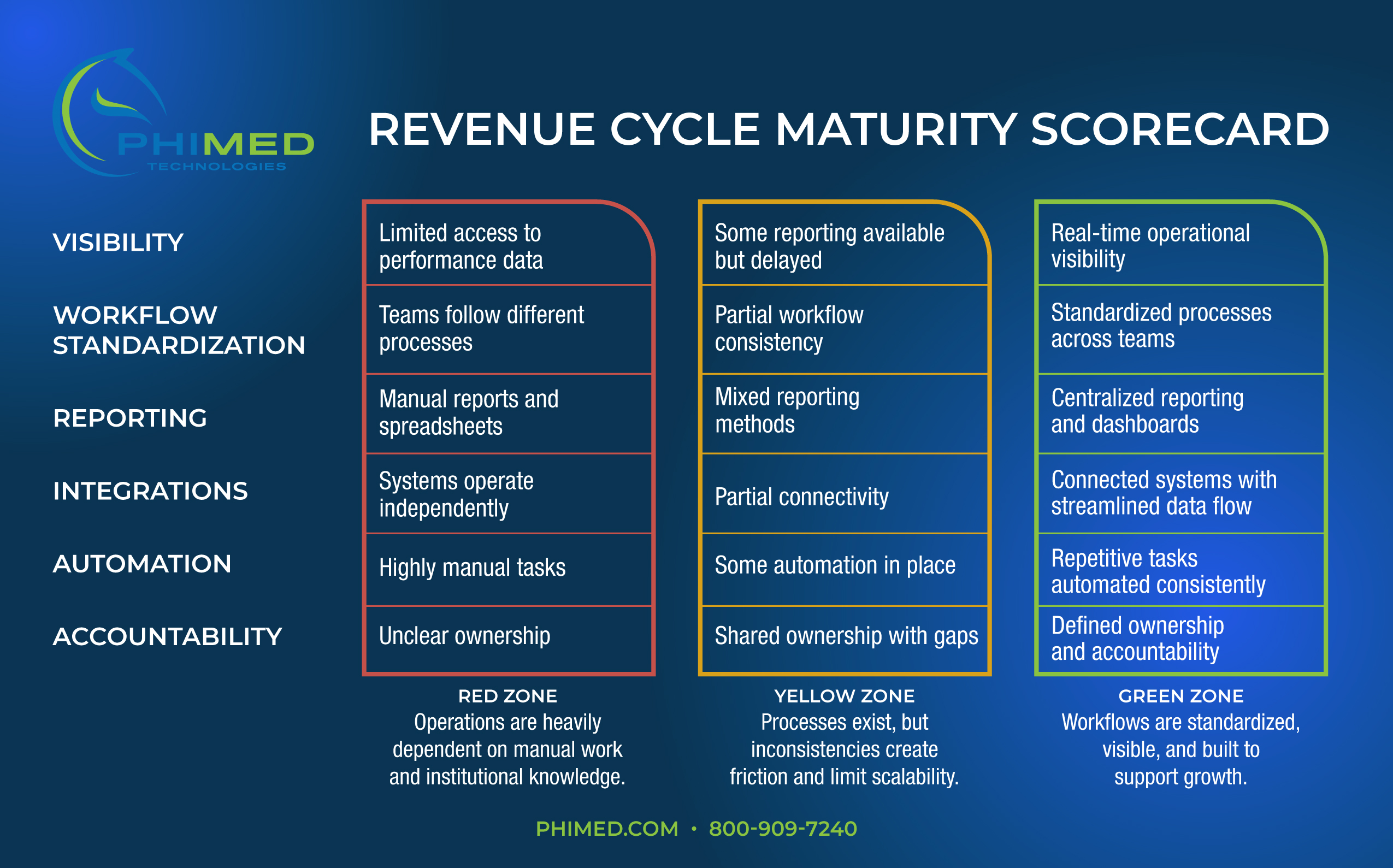
Ready to evaluate whether your reporting is accurately reveling what you need for the next stage of growth?
Schedule a discovery call with PHIMED Technologies to learn how PhyGeneSys helps organizations automate repetitive work, improve visibility, and create more efficient revenue cycle operations.