

Growth is a sign of progress. More providers, additional specialties, new locations, expanded service lines, and stronger patient access all represent opportunities for your organization to increase its impact. For you, your large physician groups, and your strategic medical billing partners, growth is often the result of years of investment.
Yet growth also introduces one of the greatest challenges facing today’s revenue cycle leaders.
Complexity.
The revenue cycle rarely struggles because organizations become larger. It struggles because operations fail to evolve alongside that growth.
Every additional specialty introduces unique documentation requirements, coding guidelines, payer contracts, and reimbursement rules. New locations often develop their own workflows. Teams grow, responsibilities shift, and reporting becomes more difficult to standardize across the organization. Over time, what was once a streamlined revenue cycle can become a collection of independent processes operating under the same umbrella.
Continuing to perform at a high level means understanding that scalability is not about adding another speciality to bill for or implementing another technology platform. It is about creating operational consistency that allows every department, specialty, and location to function as one connected revenue cycle.
Complexity Doesn’t Start With Claims. It Starts With Growth.
A five-provider specialty practice operates very differently than a multi-specialty organization with hundreds of physicians spread across multiple facilities.
As you expand through acquisitions, mergers, new service lines, or regional growth, your revenue cycle operations naturally become more sophisticated. Different specialties develop different workflows. Individual locations establish their own best practices. Teams adopt different reporting methods. You may often spend more time reconciling information than improving performance.
None of these changes are intentional. They are simply the natural result of growth.
The challenge is ensuring operational consistency grows alongside the organization.
Without a shared operational strategy, small variations become larger problems. A workflow that works well in one department may create delays in another. Reporting definitions begin to vary. Denial management becomes inconsistent. Leadership loses the ability to quickly identify where performance is improving and where additional support is needed.
Growth should strengthen an organization while never reducing visibility.
Standardization Creates Stability
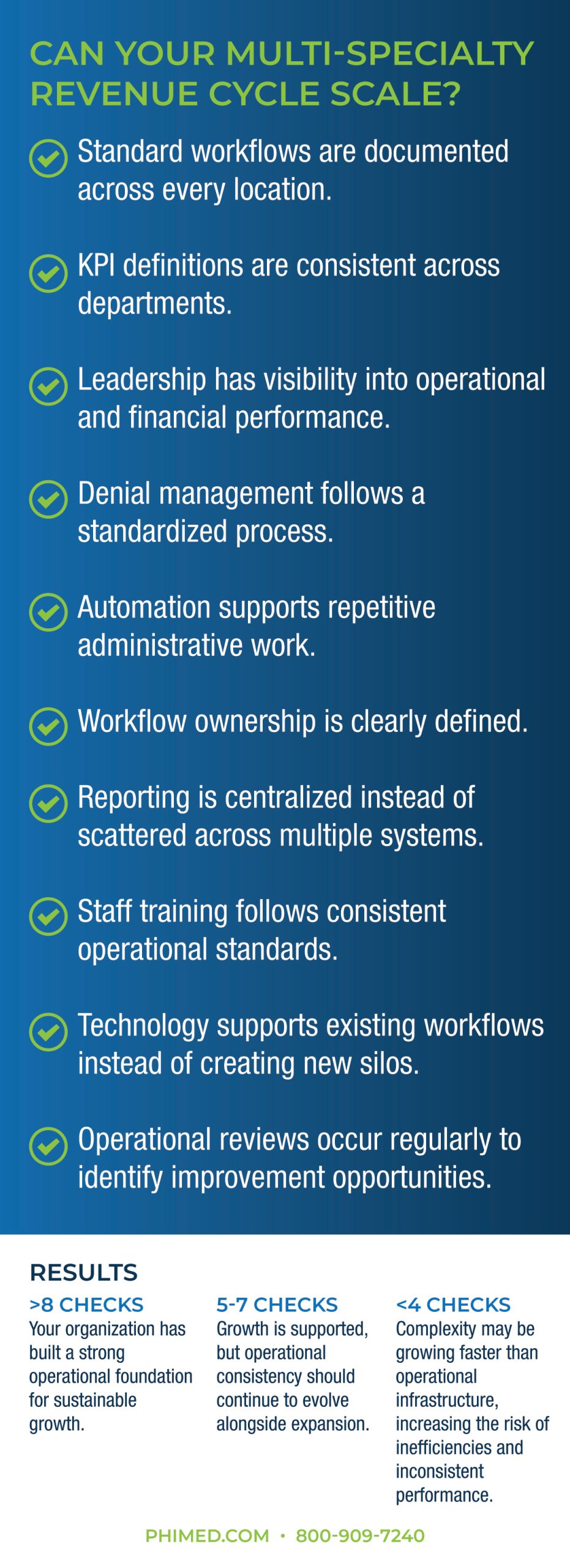
One of the defining characteristics of mature revenue cycle organizations is consistency. Not identical workflows for every specialty, but standardized operational principles that create alignment across the enterprise.
- Consistent performance metrics
- Consistent ownership
- Consistent reporting
- Consistent expectations
When departments operate from the same operational framework, leadership gains confidence that performance metrics have the same meaning regardless of specialty or location. Staff onboarding becomes easier. Cross-functional collaboration improves. Continuous improvement becomes far more achievable because teams are working toward shared objectives.
Standardization also creates resilience.
As you continue to grow, standardized processes make it easier to integrate new providers, support additional specialties, and respond to changing payer requirements without introducing unnecessary disruption.
Technology Should Reinforce Operational Excellence
Technology is an important part of scalability, but technology alone does not create operational maturity.
You may have accumulated multiple systems over time to solve individual challenges. Practice management platforms, clearinghouses, banking solutions, reporting applications, automation tools, and productivity tracking systems all provide valuable information. The difficulty arises when these systems operate independently, requiring your teams to manually connect information before meaningful decisions can be made.
Technology delivers its greatest value when it reinforces your standardized workflows rather than creating additional complexity.
Platforms like PhyGeneSys help you support Operational Intelligence by bringing workflow management, automation, reporting, and operational visibility together within a connected environment. Rather than replacing every existing system, the objective is to provide you with a comprehensive operational view that supports better decision making across your enterprise.
When people, processes, and technology evolve together, organizations create a stronger foundation for sustainable growth.
Operational Intelligence Creates Scalable Leadership
As your organization becomes more complex, your leadership requires more than historical reporting.
They need Operational Intelligence.
Operational Intelligence connects financial performance with operational activity, allowing leaders to understand not only what is happening across the revenue cycle, but why it is happening and where action should be taken.
This level of visibility allows executives to identify workflow bottlenecks before they affect cash flow, recognize denial trends before they become systemic, monitor productivity across multiple departments, and make informed decisions using trusted operational data.
For multi-specialty organizations and large medical billing companies, Operational Intelligence becomes the bridge between growth and stability.
Rather than reacting to complexity, leadership gains the ability to manage it proactively.
Continuous Improvement Is the Real Competitive Advantage
One of the biggest misconceptions about operational maturity is that you eventually reach a point where optimization is complete.
Operational excellence is never finished.
As provider groups expand, payer relationships change, automation capabilities improve, and patient expectations continue to evolve, operational strategies should evolve as well.
Even mature organizations benefit from regularly evaluating whether workflows remain consistent, reporting continues to support leadership, automation opportunities have expanded, and accountability is clearly defined across every stage of the revenue cycle.
This commitment to continuous improvement strengthens internal teams, enhances partnerships, and ensures the organization remains prepared for future growth.
Growth Should Increase Capability, Not Complexity
Every healthcare organization wants sustainable growth.
By investing in standardized workflows, shared accountability, and Operational Intelligence, large physician groups, multi-specialty organizations, medical billing companies, and in-house revenue cycle teams create an operational foundation capable of supporting long-term success.
Growth will always introduce complexity.
Operational discipline ensures complexity never becomes instability.