

Healthcare organizations rarely recognize operational ceilings while they are happening because revenue cycle teams are often remarkably effective at adapting. Staff members create workarounds, adjust workflows, compensate for system limitations, and continuously find ways to keep operations moving forward despite growing complexity. As a result, inefficiencies tend to develop gradually rather than appearing all at once, making them easy to overlook until performance begins to plateau.
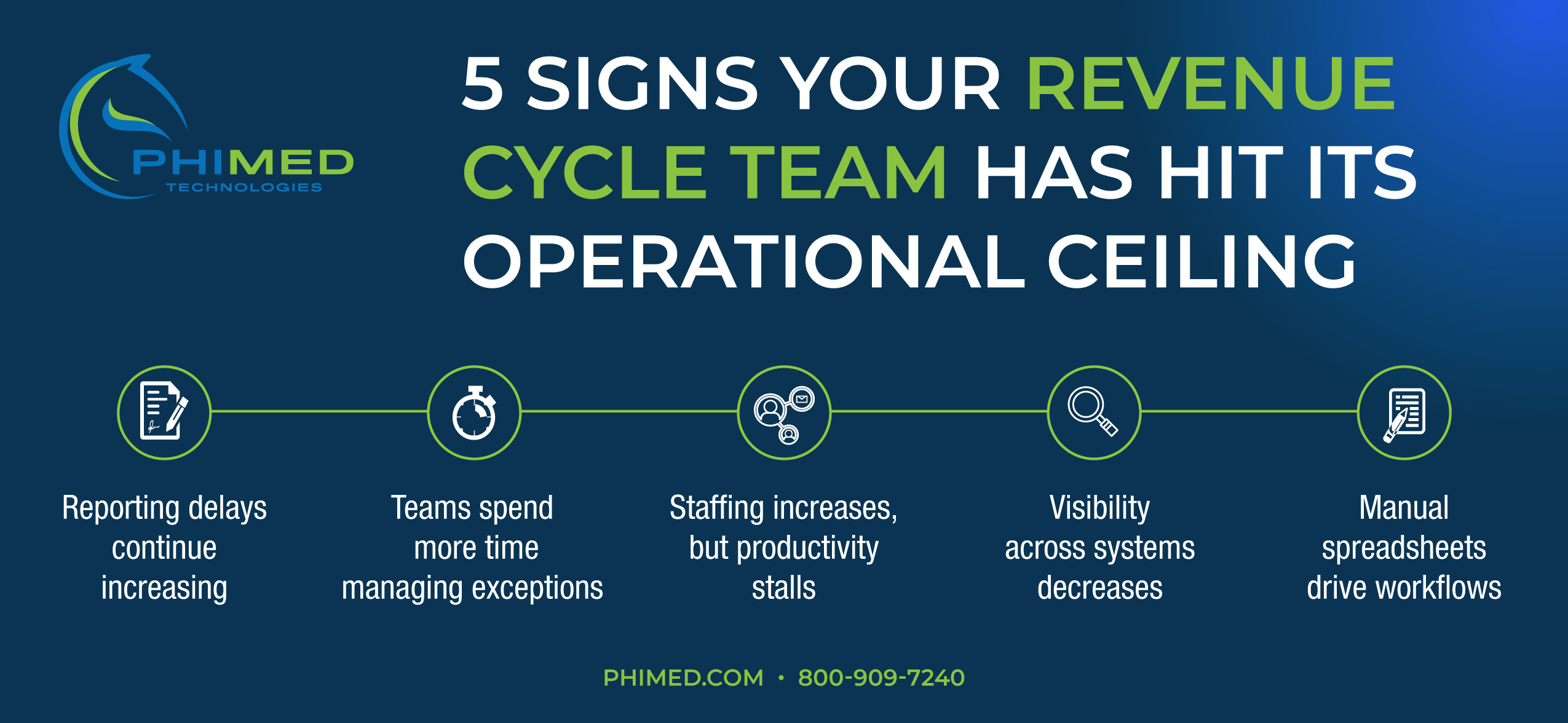
Many organizations assume operational limits are reached only when claims lag, collections decrease, or staffing challenges become impossible to ignore. In reality, operational ceilings often appear much earlier through slower reporting cycles, increased dependency on manual processes, inconsistent workflows across teams, and a growing disconnect between leadership visibility and day to day operations.
Growth Creates Complexity Faster Than Organizations Expect
As organizations expand through additional providers, specialties, facilities, or service lines, complexity increases significantly. Processes that once supported a smaller organization may struggle to support larger patient volumes, additional payer requirements, and increasingly fragmented technology environments. Growth creates more moving pieces, more exceptions, and more opportunities for inefficiencies to compound across the revenue cycle.
Internal teams frequently respond to increasing complexity by adding staff, redistributing responsibilities, or creating additional processes to fill operational gaps. While these approaches can provide temporary relief, they often increase labor costs without addressing the underlying challenges creating inefficiencies in the first place. Organizations can unintentionally scale labor instead of scaling infrastructure, creating environments where productivity gains become increasingly difficult to achieve despite larger teams and greater investment.
Manual Workarounds Become Institutionalized
One of the clearest indicators that an organization is approaching its operational ceiling is the normalization of manual workarounds. Spreadsheets developed to track denials, manually maintained reporting documents, and disconnected workflows often begin as practical solutions designed to solve immediate problems. Over time, however, these temporary fixes become embedded within daily operations and create additional complexity that limits scalability.
The challenge with heavily manual environments extends beyond efficiency concerns. Organizations that rely on disconnected workflows often experience reduced visibility, inconsistent reporting, and increased dependence on institutional knowledge held by individual employees. When critical processes depend on specific people rather than standardized systems, organizations become more vulnerable to turnover, growth challenges, and operational disruption.
As complexity increases, visibility often becomes one of the first major challenges leadership teams experience. Large medical billing companies, multi-specialty organizations, and complex provider groups require timely access to accurate operational data in order to make informed decisions. When reporting is delayed or information exists across multiple systems, organizations frequently spend more time validating information than acting on it.
This is where infrastructure becomes increasingly important. Technology investments should not simply add functionality. They should improve transparency, create operational consistency, and provide organizations with the visibility needed to identify issues before they create larger financial consequences. PhyGeneSys supports these efforts by centralizing reporting, automating workflows, and creating a more transparent operational environment that allows organizations to scale without adding unnecessary complexity.
Perhaps the most important realization organizations can make is that operational ceilings are rarely a reflection of team performance. In many cases, strong teams delay recognition of underlying problems because they consistently find ways to compensate for inefficient systems and disconnected processes. High-performing employees often mask operational weaknesses rather than expose them.
Moving Beyond the Ceiling
Organizations that successfully navigate growth typically shift their focus away from asking whether teams can continue handling more work and instead evaluate whether existing workflows, systems, and reporting structures are capable of supporting future complexity. Making this transition earlier allows organizations to improve scalability before inefficiencies become deeply embedded within operations.
Revenue cycle teams should spend their time improving financial performance and driving operational strategy rather than compensating for broken workflows. Organizations that invest in scalable infrastructure, standardized processes, and transparent reporting create environments where growth becomes more sustainable and operational ceilings become far less restrictive.