
Revenue cycle leaders are surrounded by technology. Platforms process claims. Clearinghouses move transactions. Reporting tools organize data. Automation handles repetitive work. Integrations connect systems that once operated independently.
And yet, having more technology does not necessarily mean having a better revenue cycle.
That distinction matters.
A revenue cycle can have sophisticated systems in place and still rely heavily on manual intervention. Leaders can have access to dashboards and still struggle to understand why performance is changing. Teams can automate individual processes while continuing to work around disconnected workflows. An organization can invest significantly in its technology environment and still have difficulty answering a fundamental question: Is all of this technology actually helping us operate better?
That is a very different question from whether the technology is functioning.
The real measure of RCM technology is not whether the system processes transactions, generates reports, or completes the tasks it was designed to complete. The measure is whether the technology helps the organization improve financial performance, operational efficiency, visibility and the ability to make informed decisions.
Operational Intelligence gives revenue cycle leaders a way to look beyond individual transactions and individual systems to understand how technology, workflows, people and performance interact. It shifts the conversation from “What does our technology do?” to “What is our technology enabling us to accomplish?”
Whether you’re evaluating your current RCM environment, expanding an existing operation, or looking for ways to get more from the technology already in place, that distinction can reveal more than a software comparison ever will.
1. Does your technology reduce operational friction?
The first question is deceptively simple. Is your technology making the work easier?
A system can automate a task while still creating additional work somewhere else. An integration can move information between platforms while requiring staff to monitor, reconcile or correct the information. A report can provide more data while making it harder for leadership to determine what actually matters.
Technology should reduce unnecessary steps rather than simply move them around.
That doesn’t always mean adding something new. Sometimes the opportunity is to refine an existing workflow, connect another part of the process, or better leverage capabilities already available within the technology.
When revenue cycle leaders examine their workflows through this lens, they can begin to identify where technology is creating efficiency and where it is simply creating another layer of activity.
2. Can your team see what is happening while it is happening?
Visibility is one of the foundational elements of effective revenue cycle management.
A monthly report can tell leadership what happened. A dashboard can make information easier to access. But neither is particularly valuable if leaders still have to piece together what is happening across the operation.
That distinction becomes especially important in complex organizations.
If a denial rate changes, can leadership identify the underlying trend? If A/R begins aging differently, can the organization see where the change originated? If collections shift, can the team determine whether the cause is payer behavior, workflow, staffing, technology or something else?
The value of technology is making the information useful.
3. Can you understand why performance changes?
This may be one of the most important questions a revenue cycle leader can ask.
Knowing that a KPI moved is useful. Knowing why it moved is far more valuable.
A decline in performance could be the result of a payer change, a workflow breakdown, a configuration issue, an increase in volume, a staffing challenge or an emerging pattern that has not yet become obvious.
It may also reveal an opportunity to revisit how your technology is configured, how workflows are structured, or where additional capabilities could support the process.
Technology should help leaders investigate those relationships.
When you move beyond reporting, you will create a stronger connection between the metric and the operational activity behind it.
Instead of simply knowing that something changed, leaders can begin asking what changed upstream.
4. Does your technology support the way your organization actually operates?
Every revenue cycle is different.
Specialties have different workflows. Billing organizations manage different client environments. In-house teams operate within different organizational structures. Volume, payer mix, provider models and operational priorities can vary dramatically.
Technology should accommodate the reality of the organization rather than forcing the organization to build unnecessary workarounds around the technology.
This is particularly important as organizations grow.
A process that worked for a smaller operation may become increasingly difficult to manage as volume and complexity increase. A technology environment that once provided adequate visibility may no longer provide enough insight for a larger operation.
Growth can expose weaknesses that were previously easy to overlook.
The question is whether the technology can evolve with the operation.
Evolution doesn’t always require replacing the technology. It may mean adapting workflows, expanding functionality, integrating another capability, or changing how teams use the system as organizational needs change.
Your organization may outgrow the way it uses its technology before it outgrows the technology itself.
5. Does technology help your people focus on the work that matters?
Technology should not simply make it possible to complete more tasks. It should help people spend more time on the work that requires judgment, expertise, and decision-making.
That requires understanding the difference between automation and operational improvement.
With PhyGeneSys, PHIMED Technologies works with organizations to identify where automation and workflow capabilities can reduce repetitive, rule-based work while giving teams greater visibility into revenue cycle performance. For an existing client, that conversation might mean identifying another workflow to automate, refining an existing process, integrating another capability, or finding a better way to use information already available.
That balance is increasingly important as revenue cycle organizations consider AI, automation, and other emerging technologies.
Instead of looking to, “What can we automate?” Think of it as, “What should technology handle, what should people handle and how do we know whether the combination is working?”
6. Does your technology connect performance to action?
A revenue cycle platform should not exist in isolation from the organization’s performance goals.
If net collection rate is the North Star, leaders should be able to understand what operational conditions influence it. If clean claim rate is a priority, teams should be able to see where breakdowns originate. If days in A/R are increasing, leadership should have visibility into the workflows contributing to that change.
Technology becomes more valuable when it creates a connection between what is happening, why it is happening and where the organization can act.
That broader view is at the heart of Operational Intelligence.
That is the difference between technology as infrastructure and technology as an operational asset.
7. Can your technology grow with your complexity?
Growth is often where the limitations of an RCM environment become most visible.
More providers create more volume. More clients create more variation. More specialties create more workflows. More payers create more rules. More complexity creates more exceptions.
A technology environment that requires proportional increases in manual intervention may not truly be supporting scalability.
Scalability should mean more than processing more transactions. It should mean maintaining visibility, efficiency, and control as the organization grows, as well as being able to add capabilities, integrations, workflows, and complexity without losing visibility or creating unnecessary manual work.
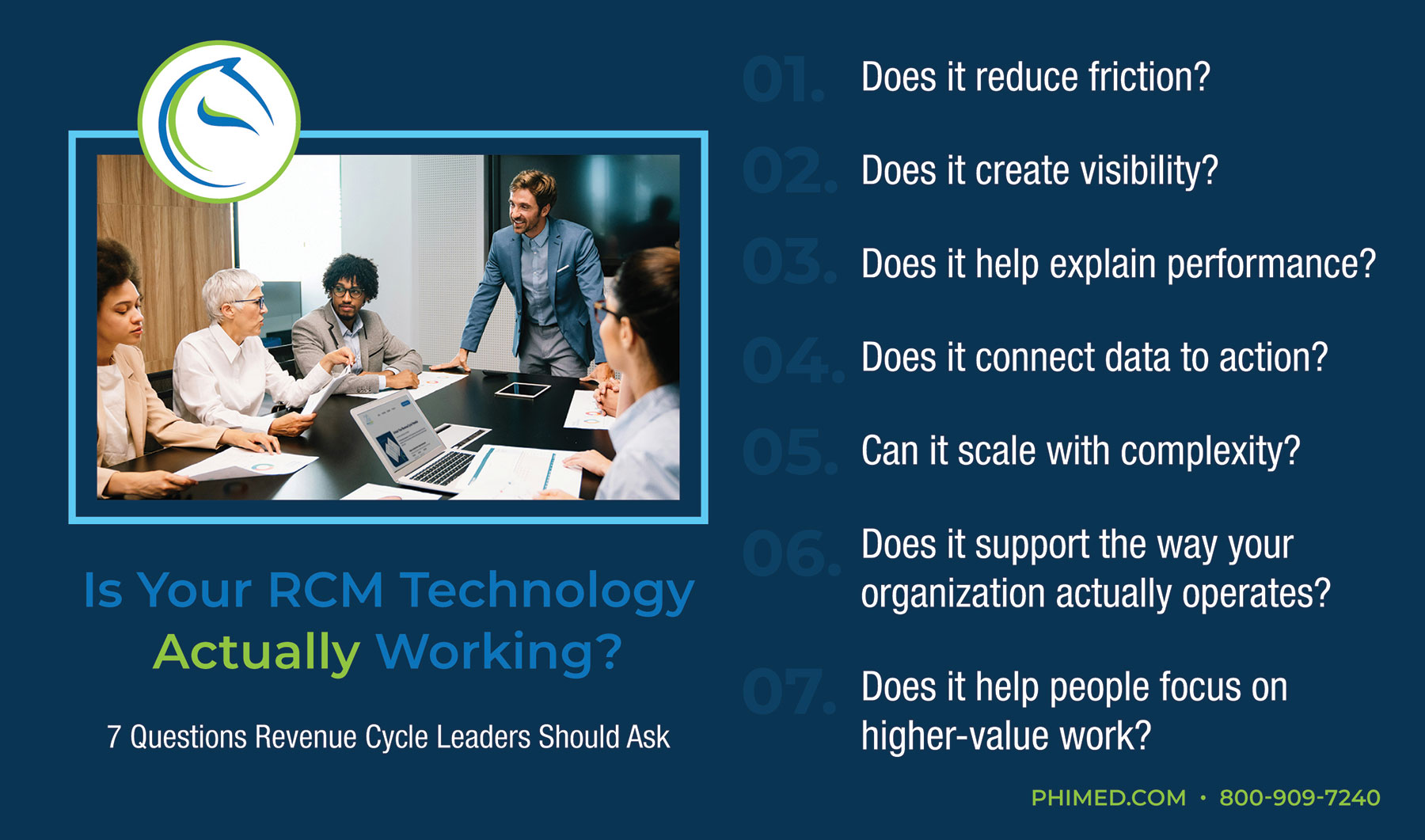
That is ultimately what revenue cycle leaders should be asking when they evaluate technology.
- Not whether the system has enough features.
- Not whether it has the newest capabilities.
- Not whether it promises automation.
Instead: Is our technology helping us understand and operate our revenue cycle better?
The technology conversation shouldn’t end at implementation. As an organization grows, its workflows change, its priorities shift, and new opportunities emerge. The question is whether the technology can evolve alongside it.
Through PhyGeneSys and our ongoing partnership with clients, PHIMED Technologies helps organizations think through how technology, workflow, automation, integrations, and performance can work together as their needs evolve.
The best technology investment is not necessarily the platform with the longest feature list, but one that helps leaders see more clearly, operate more efficiently, and make better decisions.
That’s where technology becomes part of the strategy.