

As a revenue cycle leader, you have never had access to more data. But are you using it to achieve the Revenue Cycle Transparency your organization needs?
Every claim, payment, denial, productivity report, payer response, and financial metric generates information intended to help organizations improve performance. Yet many healthcare organizations continue to struggle with the same fundamental question.
Do we truly know what is happening across our revenue cycle today?
For many organizations, the answer is more complicated than it should be.
Leadership teams often receive reports after problems have already developed. Department managers spend valuable time gathering information from multiple systems before they can identify the source of an issue. Financial discussions become focused on explaining what happened rather than preventing what happens next. While the organization technically has access to data, that information is often fragmented across practice management systems, clearinghouses, banking platforms, spreadsheets, and manual reporting processes.
This is where transparency becomes much more than a reporting function.
True revenue cycle transparency is the ability to understand operational performance as it unfolds, identify opportunities before they become financial challenges, and empower every level of leadership to make informed decisions with confidence.
Measuring performance includes building a stronger operational foundation for long-term success.
RCM Transparency Creates Confidence
You make hundreds of operational decisions every week. From staffing adjustments, workflow improvements, payer negotiations, technology investments, to process changes, your confidence in the information you reverie defines the outcome.
When reporting is delayed or inconsistent, leadership often spends more time validating data than acting on it.
When operational visibility is strong, conversations change.
Instead of asking why accounts receivable increased last month, leaders begin discussing which workflows need additional support before those numbers trend in the wrong direction.
Instead of reviewing denial reports weeks after claims have been processed, teams recognize emerging payer patterns early enough to adjust workflows before denial volumes increase.
Instead of reacting to performance, organizations begin proactively managing it.
That shift from reactive management to operational leadership is one of the defining characteristics of mature revenue cycle organizations.
Visibility Should Extend Beyond Financial Reports
Financial outcomes tell an important story, but they rarely tell the entire story.
Strong revenue cycle performance is influenced by dozens of operational factors working together every day. Claim quality, documentation accuracy, workflow efficiency, staff productivity, automation performance, payer response times, and denial management all contribute to the financial picture leadership ultimately reviews.
When those operational indicators exist in separate reports or disconnected systems, identifying the root cause of performance changes becomes significantly more difficult.
Organizations benefit most when financial and operational performance are viewed together.
This broader perspective allows leadership to understand not only what changed, but why it changed and what actions should be taken next.
Transparency becomes far more valuable when it connects operational activity to financial outcomes.
Growth Increases the Need for Operational Visibility
As healthcare organizations expand, operational complexity naturally increases.
Additional providers, specialties, facilities, service lines, and payer relationships introduce more variables into the revenue cycle. Teams grow. Responsibilities evolve. Workflows become more specialized.
Without consistent visibility, these changes often create blind spots.
A delay in one department can influence another. Workflow variations between locations may create inconsistent outcomes. Small process changes can produce significant financial consequences if they go unnoticed for weeks or months.
If you are managing a growing organization, you likely discover that the challenge isn’t collecting more information, it’s organizing it.
The challenge is organizing information into a single operational view that leadership can trust.
Rather than reviewing disconnected reports from multiple sources, mature organizations increasingly look for ways to centralize performance insights, allowing executives, managers, and operational teams to work from the same trusted information.
This creates greater alignment across departments while reducing the time spent reconciling data from multiple systems.
Transparency Supports Better Partnerships
Revenue cycle success has never depended on one department alone.
Clinical teams, registration staff, coding specialists, billing professionals, operational leadership, finance teams, technology partners, and executive leadership all influence financial outcomes.
Transparency creates a common language across these groups.
When everyone is working from consistent information, conversations become more productive. Priorities become clearer. Accountability becomes easier to establish because decisions are supported by objective operational data rather than assumptions.
The strongest partnerships are built on shared visibility.
Whether organizations manage revenue cycle operations internally, partner with outside billing organizations, or operate through a hybrid model, transparency strengthens collaboration by ensuring everyone understands the same performance goals and operational priorities.
Technology Should Simplify Visibility, Not Complicate It
Many organizations have invested in multiple technologies over the years.
Practice management systems, clearinghouses, payment platforms, reporting tools, automation solutions, and financial applications each provide valuable information. The challenge is that these systems often operate independently, requiring staff to manually assemble reports before leadership can understand overall performance.
Technology should reduce complexity, not add to it.
Platforms like PhyGeneSys are designed to support a more connected operational environment by bringing together workflow management, automation, reporting, and revenue cycle performance into a comprehensive view. Rather than replacing every existing system, the goal is to create greater visibility across the systems organizations already depend on.
As operational demands continue to grow, healthcare organizations increasingly recognize that success depends less on having more data and more on making existing data easier to understand and act upon.
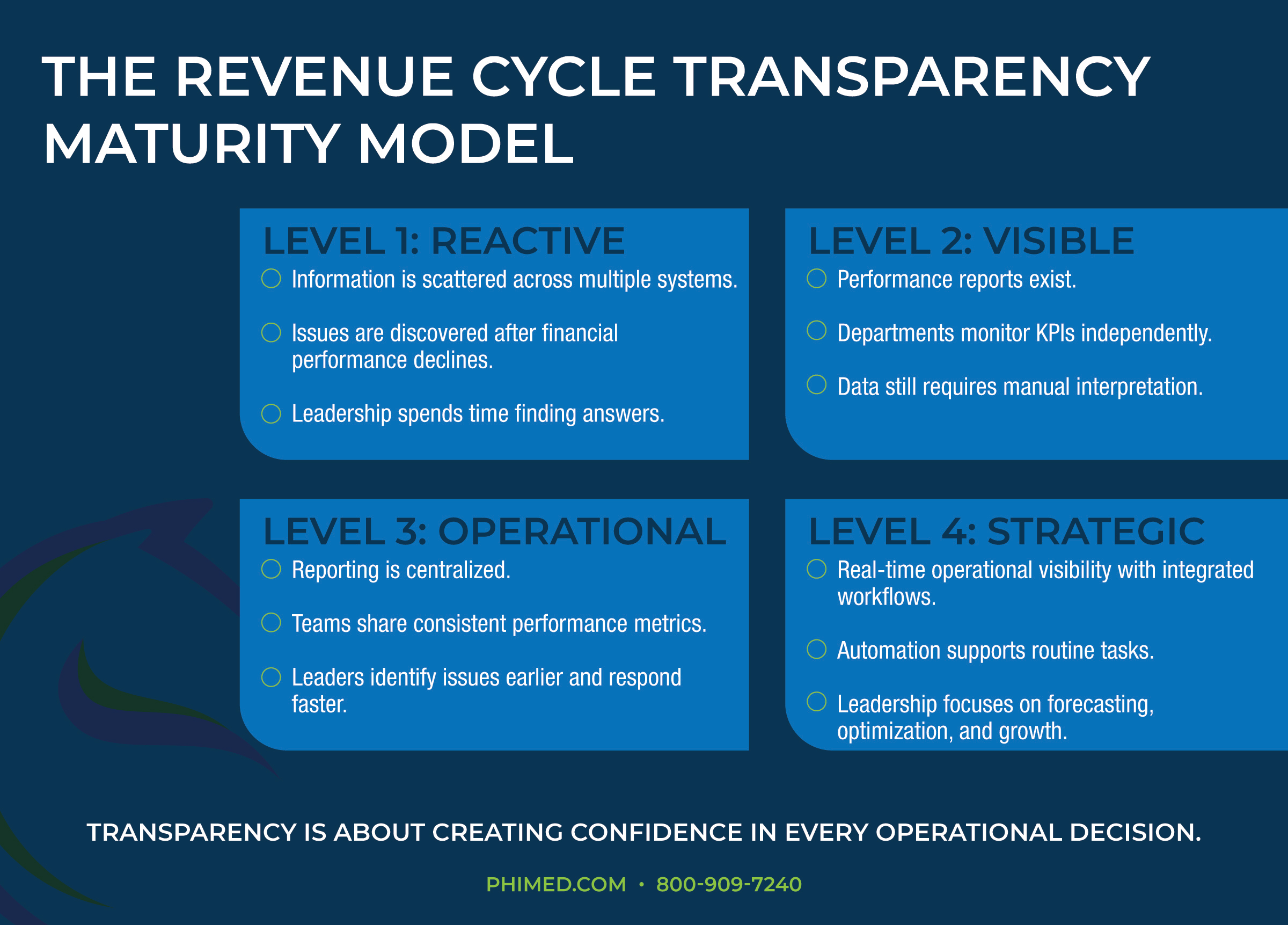
Transparency Is an Ongoing Commitment
Operational transparency is not a project that reaches completion.
Healthcare organizations continue to evolve through growth, new payer relationships, staffing changes, technology enhancements, regulatory updates, and expanding service lines. Each change creates new opportunities to improve visibility and strengthen operational performance.
Even organizations with mature revenue cycle operations benefit from regularly evaluating whether leadership has access to the information needed to make timely decisions.
If you want to maintain long-term financial performance, revisit these questions regularly:
- Are our operational and financial metrics aligned?
- Are we identifying issues early enough to prevent larger problems?
- Can leadership quickly understand performance across every department?
- Are our reporting processes supporting action instead of creating additional work?
- Have new workflows introduced areas where visibility could be improved?
When continuing to ask these questions, organizations position themselves to adapt more quickly while maintaining stronger financial performance over time.
Looking Beyond the Dashboard
Transparency has become one of the most valuable strategic assets within modern revenue cycle management.
It enables faster decisions, stronger collaboration, improved accountability, and greater confidence across every level of the organization.
Don’t settle for simply generating more reports. The most successful leaders, like you, are building operational environments where information is trusted, accessible, and internally connected to take proactive action.
As revenue cycle operations become increasingly complex, transparency will continue to separate organizations that react to change from those prepared to lead through it.
Questions Every Revenue Cycle Leader Should Be Able to Answer
| Question | Why it Matters |
|---|---|
| What is our current clean claim rate? | Indicates claim quality and first-pass success. |
| Which payers are showing increasing denial trends? | Identifies opportunities before revenue is impacted. |
| Which workflows create the longest delays? | Helps prioritize operational improvements. |
| Where is manual work slowing productivity? | Reveals automation opportunities. |
| Which locations or specialties require additional support? | Supports staffing and operational planning. |
| Are our KPIs trending in the right direction this month? | Enables proactive leadership instead of reactive reporting. |