
Revenue cycle management teams are hearing the same message from every direction: AI is the future.
Vendors are promoting AI-powered solutions. Industry publications are discussing artificial intelligence at length. Leadership teams are being asked about AI strategies, automation initiatives, and technology investments that will improve operational performance.
While artificial intelligence may eventually play a larger role in healthcare operations, many organizations are focusing on the wrong starting point.
The question should not be whether AI belongs in the revenue cycle.
The question should be whether the revenue cycle itself is operating efficiently enough to benefit from additional technology investments.
For many organizations, the greatest opportunities for improvement are not found in artificial intelligence. They are found in workflow design, operational visibility, process consistency, and intelligent automation.
The Difference Between AI and Intelligent Automation
Artificial intelligence and automation are often discussed interchangeably, but they serve very different purposes.
Artificial intelligence is designed to identify patterns, generate insights, and learn from large amounts of data. Intelligent automation focuses on executing repeatable processes accurately and consistently according to predefined rules.
In revenue cycle management, many of the most important functions do not require prediction. They require precision.
Eligibility verification, claim submission, payment posting, workflow routing, and error identification all depend on consistency. These processes succeed when they are executed correctly every time, according to payer requirements, coding standards, and organizational workflows.
This is why many healthcare organizations continue achieving measurable improvements through automation long before artificial intelligence becomes necessary. By eliminating repetitive tasks and reducing opportunities for human error, automation creates efficiency without introducing additional complexity.
Broken Processes Do Not Improve With New Technology
Organizations experiencing inconsistent workflows, fragmented reporting, or disconnected systems frequently discover that technology alone does not solve operational challenges.
Manual exceptions still require intervention. Reporting inconsistencies remain difficult to manage. Teams continue relying on spreadsheets and workarounds because the underlying processes have not changed.
In many cases, adding technology to unstable workflows simply allows inefficient processes to move faster.
Technology investments deliver the greatest value when they are built upon strong operational foundations. Without standardized workflows and clear ownership, organizations often struggle to achieve meaningful improvements regardless of the sophistication of the tools they purchase.
Visibility Must Exist Before Automation Can Deliver Value
One of the most overlooked aspects of revenue cycle performance is visibility.
Organizations cannot improve what they cannot clearly see.
When leadership lacks confidence in reporting, struggles to identify operational bottlenecks, or experiences delays accessing performance data, decision making becomes reactive rather than strategic. Teams spend valuable time validating information instead of acting on it.
Before organizations evaluate new automation initiatives, they should first understand whether they have the operational visibility necessary to support them.
- Can leadership quickly identify denial trends?
- Do teams trust the information they receive?
- Are workflows standardized across departments?
- Can data move effectively between systems?
When organizations cannot confidently answer these questions, they often discover that their greatest opportunity lies in improving visibility before investing in additional technology.
This is where infrastructure matters and platforms like PhyGeneSys help organizations centralize reporting, improve workflow consistency, and create operational transparency that supports long-term growth. When teams have access to reliable information and standardized processes, automation becomes significantly more effective.
What Organizations Should Look for in Technology Investments
The healthcare technology market is crowded with promises about innovation, intelligence, and transformation.
Organizations evaluating solutions should focus less on buzzwords and more on outcomes.
The most valuable questions are often the simplest:
- Can it automate repetitive work?
- Can it reduce preventable errors and denials?
- Can it improve operational visibility?
- Can it adapt to specialty-specific workflows?
- Can teams maintain oversight and control?
These questions often reveal more about a platform’s value than any discussion about artificial intelligence.
PhyGeneSys approaches automation through a combination of Robotic Process Automation (RPA), rules-based workflow automation, and customizable process design. Rather than relying on predictive models, the platform uses proven logic and specialty-specific workflows to automate repetitive tasks, identify issues before claims are submitted, and create greater operational consistency across teams.
The result is reliable automation that supports staff, improves efficiency, and maintains transparency throughout the revenue cycle.
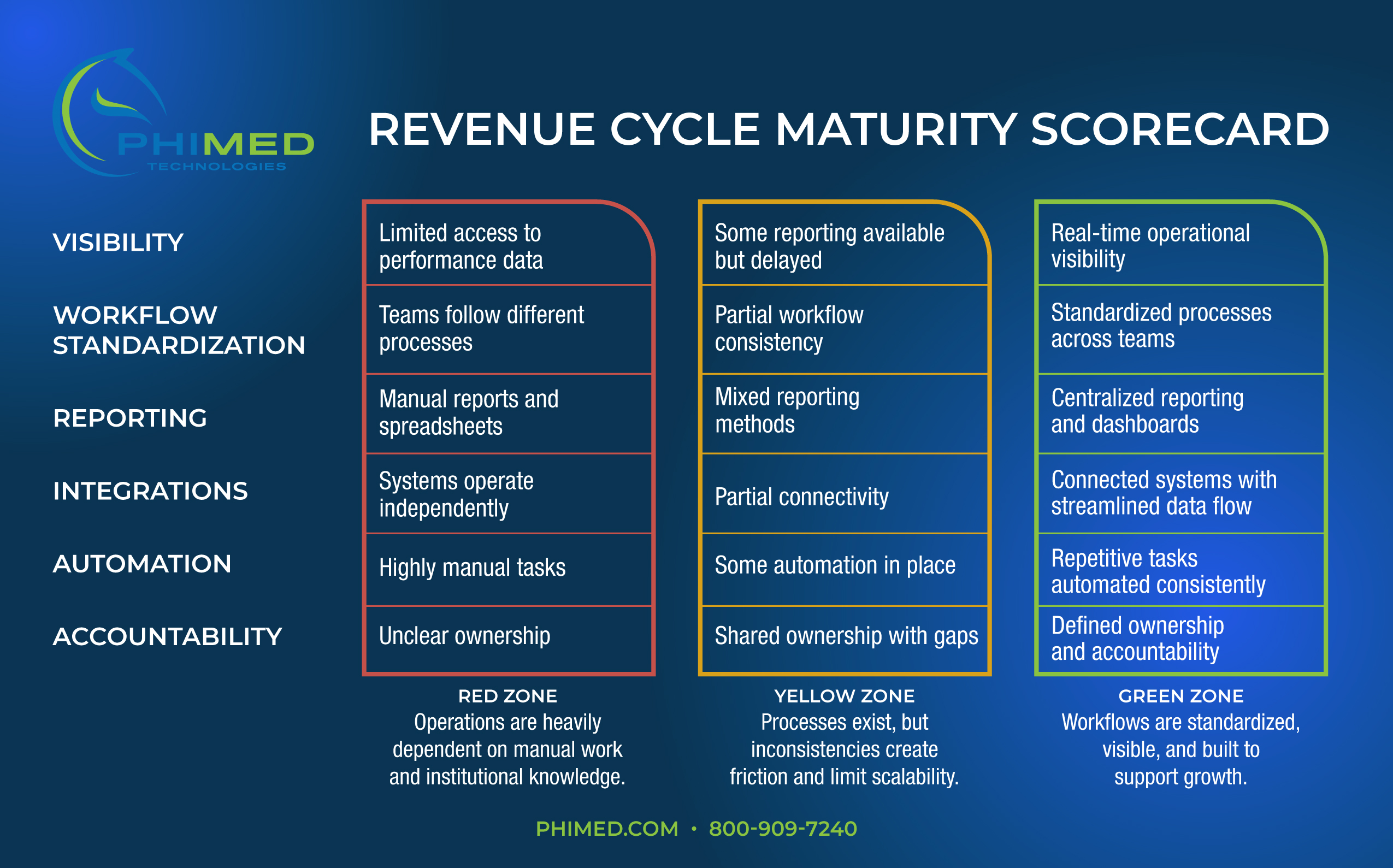
Is Your Organization Ready for Greater Automation?
Organizations answering “no” to multiple areas may benefit more from workflow optimization and process improvement than from introducing additional technology layers.
Technology Should Support Strong Operations
Conversations about AI often focus on replacing work. The more important conversation focuses on improving how work moves throughout the organization.
Revenue cycle management remains highly nuanced, requiring teams to navigate payer requirements, compliance regulations, specialty-specific workflows, and operational exceptions. Technology performs best when it supports well-designed systems rather than attempting to compensate for operational inconsistency.
Organizations generating the strongest results from technology investments are rarely those adopting trends the fastest. More often, they are organizations that invest in transparency, workflow optimization, automation, and operational discipline before pursuing more advanced initiatives.
Technology trends will continue to evolve. New tools will emerge, and new capabilities will enter the market.
When focused on the fundamentals, the goal becomes building a revenue cycle that performs more efficiently, scales more effectively, and provides the visibility necessary to make better decisions.
Whether that improvement comes from workflow optimization, intelligent automation, or future technologies matters far less than whether it creates measurable results.
Ready to evaluate whether your workflows are prepared for the next stage of growth? Schedule a discovery call with PHIMED Technologies to learn how PhyGeneSys helps organizations automate repetitive work, improve visibility, and create more efficient revenue cycle operations.