

Growth is usually good news for a healthcare organization. More providers. More patients. More specialties. More locations. More revenue. But revenue cycle leaders know what can happen next.
More volume starts creating more work. A new specialty brings different workflows. An acquisition introduces another system. Payer requirements create new exceptions. Teams build workarounds to keep things moving.
The organization is growing and the revenue cycle is getting bigger, but bigger and more scalable are not the same thing.
For medical billing companies and healthcare organizations managing increasingly complex revenue operations, the distinction matters. Growth can increase revenue while also increasing the cost and complexity of getting that revenue collected. If the infrastructure supporting the revenue cycle does not keep pace, the organization can find itself adding labor, oversight and technology simply to maintain the performance it already has.
Scaling efficiently means building an operation that can absorb growth without allowing those demands to increase at the same rate.
Growth Creates Complexity. Scale Creates Capacity.
Healthcare already operates within a highly complex administrative environment. Administrative costs account for roughly one-quarter of U.S. healthcare and hospital expenditures, according to recent research published in JAMA Health Forum. As medical billing organizations grow, that complexity can multiply across specialties, payers, clients, locations, and technology platforms. The challenge is not simply managing more work. It is building an operation that can absorb more volume without allowing administrative complexity to grow at the same rate.
Revenue cycle operations carry a significant portion of that complexity.
Large medical billing organizations may manage multiple specialties, payers, client requirements, locations, workflows and technology platforms at the same time. Healthcare organizations expanding through new providers, service lines or acquisitions can face similar challenges. Every addition creates another set of requirements the revenue cycle has to accommodate.
That doesn’t mean growth is the problem. It means growth exposes the strength of the underlying operation.
A process that works well for one specialty may become difficult to manage across five. A reporting process that works for one client may become cumbersome across dozens. A team that can keep up with exceptions at a smaller volume may struggle when those exceptions multiply.
At some point, adding more resources to keep pace becomes less sustainable than improving the way the work itself moves.
The Warning Signs Are Usually Small
The warning signs are rarely dramatic at first. They tend to appear as small operational compromises that make sense in the moment and gradually become part of the permanent process.
A team may add a spreadsheet to reconcile information between systems because the existing reports don’t provide the view they need. Someone may create a manual queue to catch an exception that the standard workflow doesn’t address. A manager may become the person everyone calls when a claim doesn’t behave as expected because that knowledge has never been built into the broader process. A new specialty may be added to an existing workflow even though its requirements don’t quite fit. An acquisition may introduce another platform that operates alongside the systems already in place.
None of those decisions necessarily looks significant on its own.
The problem is what happens when they accumulate. The revenue cycle becomes increasingly dependent on manual intervention, institutional knowledge and individual workarounds to maintain performance.
That dependency becomes more expensive as volume increases.
A growing organization needs more than the ability to process additional work. It needs an operating model that can accommodate change without continually adding layers of complexity around it.
What Does It Take to Scale an RCM Operation?
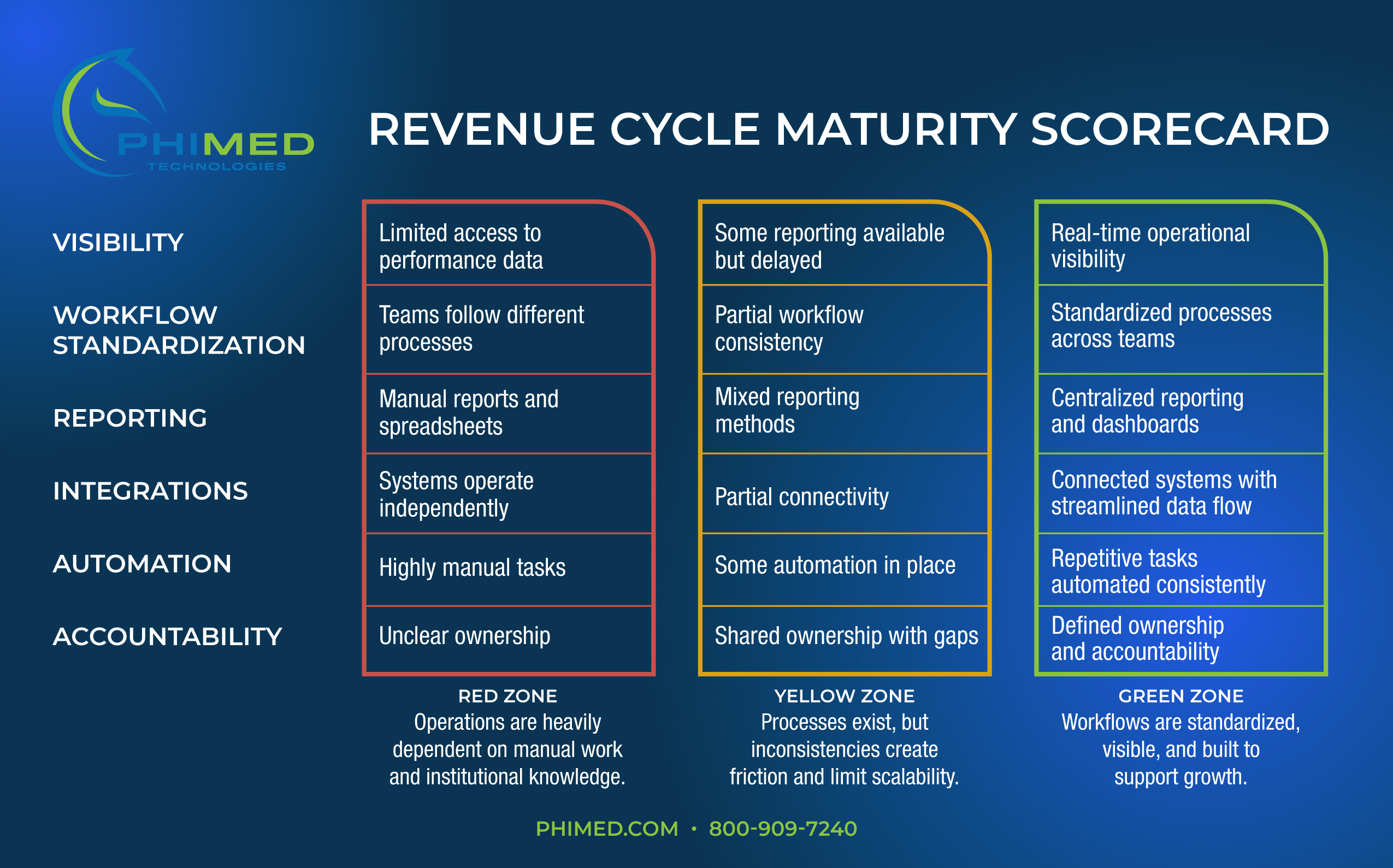
There is no single technology, staffing model or process that creates scalability. For medical billing organizations and healthcare revenue cycle teams, it is usually the combination of several capabilities working together.
- Workflows that can accommodate change
A scalable revenue cycle has enough structure to create consistency while remaining flexible enough to accommodate different specialties, payer requirements and client needs.
That becomes particularly important as organizations expand. Adding a specialty shouldn’t require rebuilding the revenue cycle from the ground up, and adding a new client shouldn’t automatically mean creating another collection of spreadsheets, queues and workarounds.
The more repeatable the underlying process, the easier it becomes to extend it.
- Technology that supports the operation
Technology has an important role in scalability, but the question isn’t simply whether a platform has more features.
The more important consideration is how the technology supports the way work actually moves through the revenue cycle.
Can information move between systems without unnecessary intervention? Can rules and workflows accommodate changing requirements? Can teams see what needs attention? Can the organization add volume without adding another layer of manual oversight?
Technology should give the operation room to grow rather than become another source of complexity it has to manage.
- Visibility into what is happening
Growth becomes much harder to manage when leaders can see the results but not the reasons behind them.
A dashboard may show that collections changed, A/R increased or denial rates moved. Operational visibility goes a step further by helping leaders understand where the change originated, what is contributing to it and where attention is needed.
That distinction becomes increasingly valuable as organizations grow more complex. When information is spread across systems, specialties and teams, leaders need a clear view of performance to identify emerging issues before they become larger operational problems.
This is where data becomes more than reporting. It becomes a tool for making decisions.
- Processes that reduce unnecessary intervention
A scalable operation does not require people to touch every account simply because the process has always been designed that way.
Routine, rules-based work can often be handled through better workflow design, technology and automation. That allows revenue cycle professionals to spend more of their time on exceptions, problem-solving, account resolution and decisions that require experience.
Scalability isn’t about removing people from the revenue cycle. It is about using skilled revenue cycle professionals where their expertise creates the most value.
- A clear understanding of capacity and performance
Capacity is often treated as a staffing question: How many people do we need to handle the projected volume?
For a growing RCM operation, that is only part of the equation.
Capacity is also influenced by how many times work is touched, how long it waits between steps, how often it is returned for correction, how much management intervention is required and how much time teams spend moving or reconciling information.
Those factors help explain why two organizations with similar volumes can have very different operating costs and performance.
Understanding those relationships gives leadership a much better foundation for deciding where additional resources are needed and where the existing operation has opportunities to create capacity.
The Business Case for Scaling Efficiently
Scaling efficiently is ultimately a business decision.
When revenue grows but the cost of managing that revenue grows at the same pace, the organization may be getting larger without becoming more productive. Additional staffing, management oversight, technology and administrative effort can absorb a meaningful portion of the benefit created by growth.
The opposite is also true.
When an organization can increase volume while maintaining consistent processes, improving visibility and reducing unnecessary effort, it creates operating leverage. The revenue cycle can support more business without requiring every increase in volume to be matched by an equivalent increase in resources.
That has implications beyond the billing department.
It can affect margins, staffing requirements, service capacity, response times and the organization’s ability to take on new clients, specialties or locations. For large medical billing companies, it can influence how profitably the organization can grow. For healthcare organizations, it can determine whether revenue cycle infrastructure becomes an enabler of expansion or a constraint on it.
The cost of revenue cycle complexity becomes more significant as volume grows. A 2022 Health Affairs study found that billing and insurance-related costs for inpatient bills reached as much as $215 per bill in the United States, with eligibility, coding, submission, and rework among the activities driving that cost. For a growing medical billing organization, even relatively small amounts of additional work per claim can become substantial when multiplied across thousands of claims.
That makes the economics of the revenue cycle worth examining closely as an organization grows.
The Hidden Cost of Growing Without Scaling
The most obvious cost of an increasingly complex revenue cycle is labor, but labor is only one part of the equation.
Complexity can create additional touches, longer turnaround times, more management oversight and greater reliance on experienced employees who know how to navigate exceptions. It can make training more difficult because processes are harder to explain and less standardized. It can make performance harder to evaluate because information is spread across systems and teams.
It can also make change more difficult.
A new payer requirement may require multiple process updates. A new specialty may need another workflow. A system change may require additional reconciliation. An acquisition may introduce another set of technology and reporting requirements.
The larger and more interconnected the operation becomes, the more expensive those changes can be when the underlying infrastructure is difficult to adapt.
Scaling gives the organization a way to approach that complexity deliberately rather than continually working around it.
A Useful Question for 2027 Planning
As medical billing companies and healthcare organizations plan for 2027, projected volume and staffing requirements are important numbers to have. They shouldn’t be the only ones on the table.
A more useful planning exercise is to look at how much additional volume the current operation can absorb before labor, complexity and management effort begin increasing disproportionately.
What happens if claim volume increases by 10%? What happens if a new specialty is added? What happens if another location or client comes into the operation? Where would the additional work go, and what would have to change to support it?
Those questions can reveal opportunities that aren’t obvious in a traditional staffing or technology plan.
The objective isn’t to build an RCM operation that never changes. Healthcare won’t allow that. The objective is to build one that can change without having to reinvent itself every time it grows.
A growing revenue cycle is a sign that an organization is moving forward.
The challenge is making sure the infrastructure underneath that growth can keep pace.
For medical billing companies and healthcare organizations alike, scaling means creating the capacity to support more providers, more claims, more specialties and more complexity while maintaining financial performance and operational control.
That requires more than adding resources. It requires understanding how the operation works, where complexity is accumulating, how technology and information move through the organization, and where the revenue cycle can create additional capacity.
Growth gets you bigger.
Scalability determines how well you can handle what comes next.
Schedule a discovery call with PHIMED Technologies to learn how PhyGeneSys helps organizations scale with a more efficient revenue cycle operation.