

Automation has become an increasingly important part of revenue cycle strategy. Organizations are looking for ways to reduce manual work, improve efficiency, manage growing volumes and create more capacity without continuously adding staff.
Those are worthwhile goals. The challenge is that automation can be easy to measure as a technology initiative and much harder to measure as an operational improvement.
An organization may know how many processes have been automated. It may know how many workflows use robotic process automation. It may know how many tasks a system can perform without human intervention.
Those numbers matter, but they do not tell the whole story.
The more important question is what happened to the work.
How many manual touches disappeared? How much rework was eliminated? How many errors were prevented? How much staff capacity was created? Did claims move through the workflow faster? Did preventable denials decrease? Did revenue reach payment more quickly?
Those are the measures that reveal whether automation is creating meaningful operational value.
1. Start With the Work
Before determining whether a process should be automated, revenue cycle leaders need to understand the work itself.
A useful workflow review should answer several questions:
- What steps are required to complete the process?
- How many people interact with it?
- How many systems are involved?
- How many manual touches occur?
- How frequently does the process occur?
- Where does information have to be re-entered?
- Where does work wait for another person or system?
- How often does rework occur?
- What types of errors occur?
- How frequently does the process create an exception?
- What happens when the process is delayed?
- What financial impact can the delay create?
This level of examination matters because automation applied to a poorly understood process may simply move the problem somewhere else.
A strong automation opportunity usually becomes easier to identify once the organization understands where repetitive work consumes time and where predictable steps can be handled more consistently through technology.
2. Measure the Manual Work That Disappears
One of the clearest measures of automation value is the number of manual touches eliminated.
Consider a process that requires staff to move information between systems, verify a status, update an account, document the result and move the account to its next step. If that sequence happens thousands of times, even small inefficiencies can create significant operational cost.
After automation, leaders should be able to determine how much of that work has disappeared.
That measurement can include:
- Manual touches eliminated
- Staff hours reduced
- Repetitive data entry removed
- Manual status checks reduced
- Duplicate work eliminated
- Work queues reduced
- Handoffs decreased
- Processing time shortened
This creates a much clearer picture of capacity.
The organization is no longer measuring automation simply because automation exists. It is measuring what the automation allowed the organization to stop doing manually.
3. Look for Rework
Rework is one of the quieter sources of revenue cycle inefficiency.
A task may appear to be completed, but then someone has to return to it because information was missing, an entry was incorrect, a claim failed, a workflow was interrupted or another step was overlooked.
That second touch consumes capacity without moving the operation forward.
When evaluating an automation opportunity, leaders should examine:
- How often work has to be repeated
- Which processes create the most rework
- What causes the rework
- Whether the cause is predictable
- Whether technology could prevent the issue
- Whether the workflow itself needs to change
Reducing rework can have a meaningful impact because the organization gains more than time. It also reduces the number of opportunities for another error or delay to enter the process.
4. Measure Errors Before They Become Denials
Automation can also create value earlier in the revenue cycle.
When repetitive processes rely heavily on manual data entry or manual decision-making, there can be more opportunities for inconsistency. Those errors may eventually appear as rejected claims, corrected claims, delayed claims or denials.
That makes error prevention an important automation measure.
Revenue cycle leaders should ask:
- Where are manual processes creating preventable errors?
- Which errors occur repeatedly?
- Can they be identified before submission?
- Can the workflow prevent the error from occurring?
- Can a rules-based process handle the correction or validation consistently?
When the answer is yes, automation may have an opportunity to improve both efficiency and financial performance.
5. Connect Automation to Denial Reduction
Denial management is often discussed as a separate function, but automation and workflow design can play an important role in prevention.
If a recurring denial has an identifiable upstream cause, the organization has an opportunity to examine the process that allowed the issue to reach the payer.
That might involve validating information earlier, routing an account differently, standardizing a workflow or automating a repetitive verification step.
When measuring the impact, look beyond the number of denials worked.
Consider:
- Preventable denials reduced
- Recurring denial categories reduced
- Manual denial touches reduced
- Rework associated with denials reduced
- Time from denial identification to resolution
- Financial value associated with prevented denials
The goal is to understand whether automation is helping prevent unnecessary work from entering the revenue cycle in the first place.
6. Examine Exceptions
Exceptions deserve special attention because they often reveal where a workflow is struggling.
An exception is a situation that requires additional intervention because the standard process cannot proceed as designed. Some exceptions are necessary. Others occur because the workflow has not been designed to accommodate a predictable situation.
A useful review should identify:
- Which exceptions occur most frequently
- Which exceptions consume the most staff time
- Which exceptions are predictable
- Which exceptions require human judgment
- Which exceptions could be addressed through workflow changes
- Which exceptions could be handled through automation
This distinction is important because automation should not remove human judgment where human expertise is necessary.
Instead, automation can handle predictable work and allow staff to concentrate on the situations where their experience and decision-making create greater value.
7. Measure Staff Capacity, Not Just Staff Time
Reducing manual work creates capacity.
The next question is what the organization does with it.
If automation saves several hours of repetitive work each day, that capacity can be redirected toward activities that require more attention. Teams may be able to spend more time resolving complex accounts, investigating root causes, managing exceptions, strengthening payer follow-up or addressing workflow issues.
That makes staff capacity an important measure of automation success.
Consider:
- How much time was freed?
- Where was that capacity redirected?
- Did the team’s ability to address higher-value work improve?
- Did the organization gain capacity without increasing headcount at the same rate as volume?
Automation becomes more meaningful when the capacity it creates contributes to stronger operational performance.
8. Measure the Impact on Payment Velocity
Ultimately, revenue cycle efficiency has a financial destination.
Revenue needs to move through the operation and become payment.
That means automation should be evaluated in the context of payment velocity as well as task efficiency.
Leaders should examine whether workflow improvements contribute to:
- Faster claim processing
- Fewer submission delays
- Faster resolution of exceptions
- Reduced rework
- Fewer preventable denials
- Shorter time to resolution
- Improved A/R performance
- Faster movement from earned revenue to collected revenue
Not every automation will have a direct or immediate impact on payment timing. That is why the relationship between the workflow change and the financial outcome needs to be understood rather than assumed.
This creates a much stronger measurement framework than simply tracking how many automated processes an organization has deployed.
Automation Should Be Part of an Improvement Cycle
The most effective automation strategies are connected to continuous operational improvement.
A workflow is examined. The organization identifies unnecessary work or a recurring source of friction. The process is redesigned where appropriate. Automation is introduced where it can reliably improve the work. Performance is measured after implementation. The organization then determines whether additional refinement is needed.
That cycle can continue.
It is one of the practical applications of Operational Intelligence.
Visibility helps identify where work is occurring. Analysis helps explain why it is occurring. Workflow improvement addresses the underlying process. Automation removes repetitive work where appropriate. Measurement shows whether the change produced the intended result.
Then the organization has another opportunity to iterate.
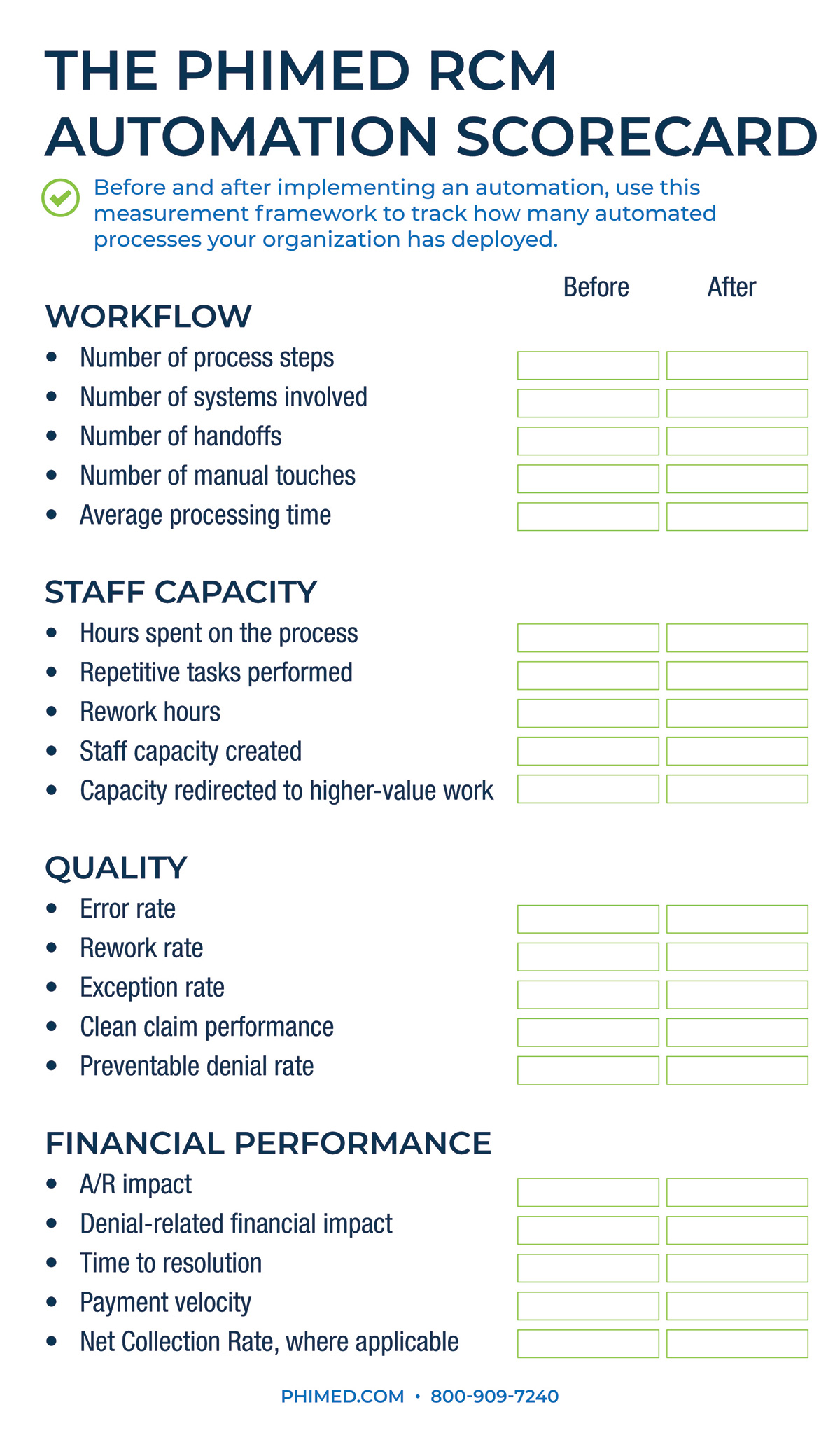
Use the RCM Automation Scorecard
The Goal Is a Better Operation
Automation is valuable because it can help revenue cycle organizations accomplish more with the resources they have. Its value becomes much clearer when leaders measure the operational work it removes and the performance improvements that follow.
The strongest automation strategy is therefore not built around a technology adoption number.
It is built around questions that connect technology to the work:
- What did we eliminate?
- What became faster?
- What became more consistent?
- What errors were prevented?
- What denials were avoided?
- What capacity was created?
- What changed in the financial outcome?
For organizations using PhyGeneSys, automation and workflow capabilities can support this approach by reducing repetitive work and helping teams create more efficient, measurable processes.
The goal is not automation for its own sake.
The goal is a revenue cycle that requires less unnecessary work, creates more operational capacity and moves revenue through the organization with greater consistency and speed.
Measure the technology. Then measure what the technology changed.